Crochet Table Runner: A Simple V-Stitch Pattern in Cotton
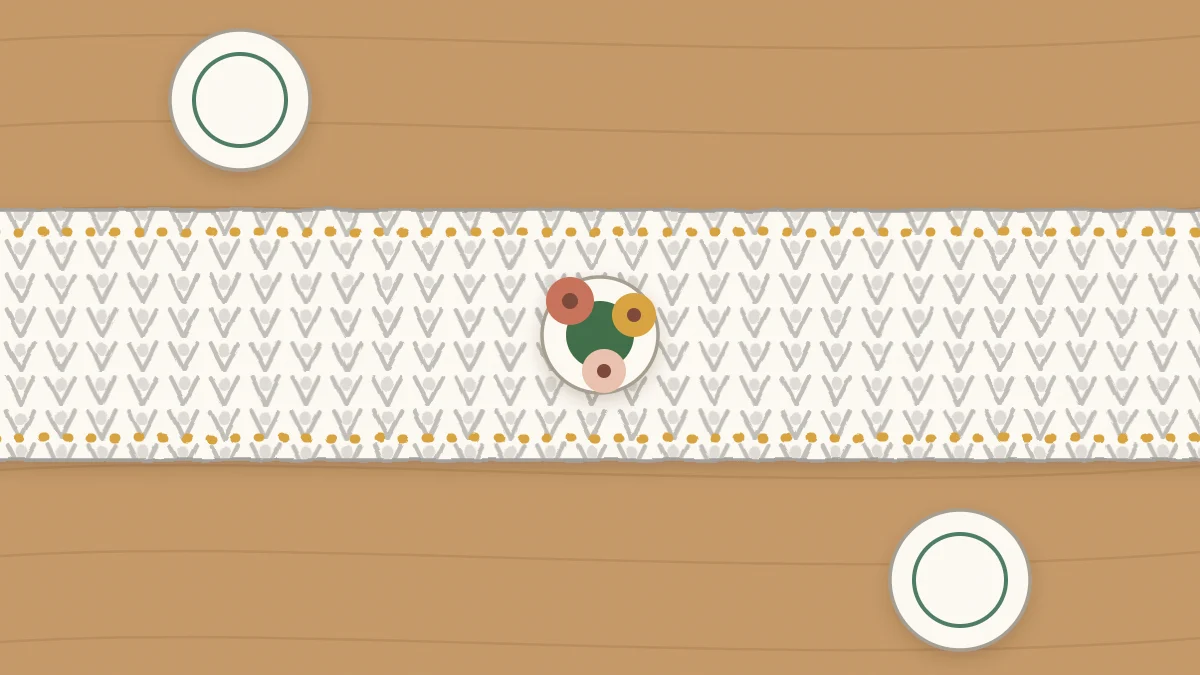
A lacy but simple crochet table runner in worsted cotton, about 14 x 60 in. One repeating V-stitch row, a clean border, blocking steps and a length table for other tables.
Project at a glance
Materials
- About 400 to 450 yd (366 to 411 m) worsted-weight cotton
- H-8 (5 mm) crochet hook
- Yarn needle
- Scissors and tape measure
- Blocking mats and rust-proof pins
This crochet table runner is worked in V-stitch, an open pattern that looks like lace but repeats one simple row from start to finish. In worsted cotton it measures about 14 x 60 in (36 x 152 cm), and because it grows along its length, you can stop at whatever size suits your table.
Materials
- Worsted-weight (#4) cotton: about 400 to 450 yards (366 to 411 m)
- H-8 (5 mm) crochet hook
- Yarn needle and scissors
- Tape measure
- Blocking mats or towels and rust-proof pins
Cotton is the practical choice for a table. It lies flat, shows the open stitch clearly and stands up to regular washing. A cotton-linen blend drapes a little more softly. Stretchy or fuzzy yarns blur the V shapes and are harder to block square.
Gauge and stitch abbreviations
Gauge: 5 V-sts and 7 rows = 4 in (10 cm), measured after blocking. Each V-st is about 0.8 in (2 cm) wide.
The runner has 16 V-sts with one dc at each edge. That is 16 x 0.8 = 12.8 in, plus about 0.6 in for the two edge stitches and 0.6 in for the border, for a finished width of 14 in. Lengthwise, 104 rows at 7 rows per 4 in come to about 59.4 in, and the border brings that to 60 in.
- ch: chain
- sc: single crochet
- dc: double crochet
- V-st: (dc, ch 1, dc) all in the same stitch or space
- sk: skip
- sp: space
- sl st: slip stitch
- rep: repeat
Sizing: length, drop and overhang
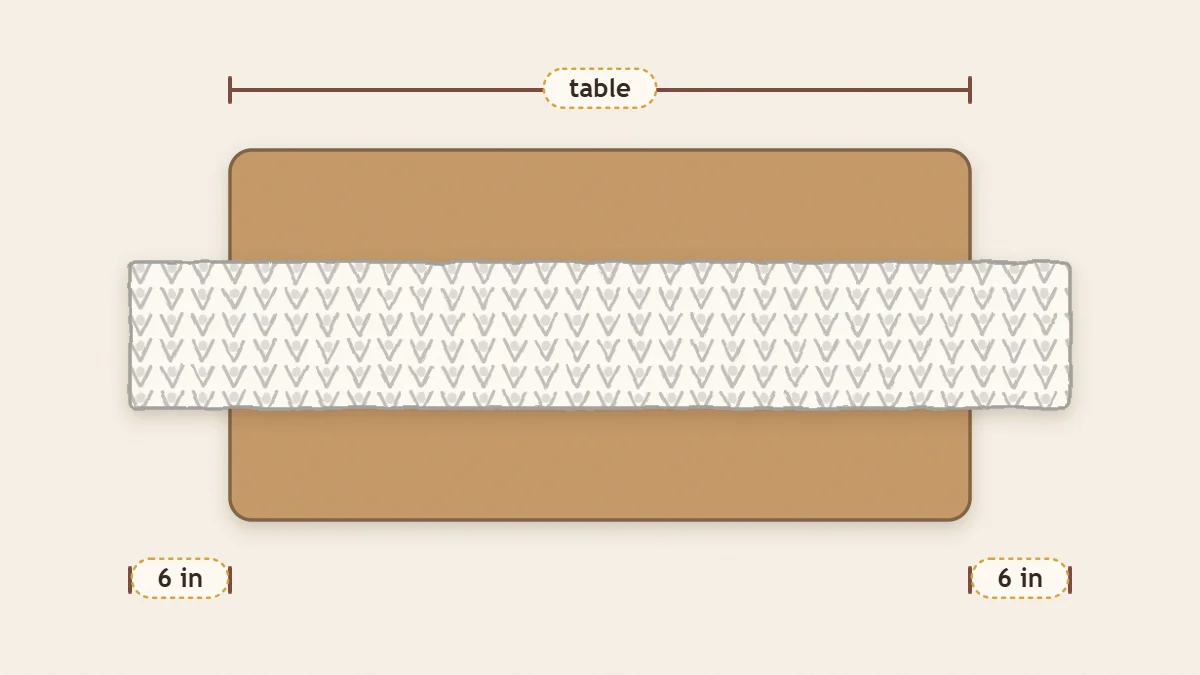
A runner usually looks balanced at about a third of the table’s width, which is why 14 in suits most dining tables. For the length, you have two options. A runner with a drop hangs over each end, commonly by about 6 in (15 cm). A runner without a drop stops 6 in or more short of each end and works well under a centerpiece.
Measure the table, add the overhang twice, and read the row count from the table below. The figures assume a 6 in drop at each end.
| Table length | Runner length | Rows | Yarn (approx.) |
|---|---|---|---|
| 36 in (91 cm) | 48 in (122 cm) | 83 | 340 yd (311 m) |
| 48 in (122 cm) | 60 in (152 cm) | 104 | 425 yd (389 m) |
| 60 in (152 cm) | 72 in (183 cm) | 125 | 510 yd (466 m) |
| 72 in (183 cm) | 84 in (213 cm) | 146 | 600 yd (549 m) |
For any other length, subtract 0.6 in for the border and multiply by 1.75 rows per inch. To change the width, add or remove 3 chains for each V-st. The general method is in how to size crochet home decor.
V-stitch table runner pattern
The runner is worked in short rows across its 14 in width. The turning ch 3 counts as a dc throughout.
- Foundation: Ch 52.
- Row 1: Sk the first 4 ch from the hook (the first 3 count as a dc). V-st in the next ch. *Sk 2 ch, V-st in the next ch; rep from * until 2 ch remain. Sk 1 ch, dc in the last ch. (16 V-sts and 2 dc)
- Row 2: Ch 3, turn. V-st in the ch-1 sp of each V-st across. Dc in the top of the turning chain. (16 V-sts and 2 dc)
- Rows 3 to 104: Rep Row 2. The piece should measure about 13.4 x 59.4 in (34 x 151 cm) once blocked. Do not fasten off.
Tip
The last dc of every row goes into the top of the turning chain, which is easy to miss. If your edges start to slant inward, count: every row should have 16 V-sts with a single dc on each side.
Border
One round of single crochet straightens the edges and gives the pins something firm to hold during blocking.
- Ch 1, turn. Work 50 sc across the short edge: 1 sc in each dc and 1 in each ch-1 sp. Ch 2 for the corner.
- Rotate and work 208 sc along the long edge, placing 2 sc around the stitch at the end of each row. Ch 2.
- Work 50 sc along the foundation chain, ch 2, then 208 sc along the second long edge, ch 2.
- Sl st to the first sc and fasten off. (516 sc and 4 ch-2 corner sps)
If you changed the length, the long edges simply take 2 sc for every row you worked.
Blocking
Open stitches need blocking more than solid ones. Straight off the hook the fabric draws in and the V shapes close up; blocking opens them and sets the final measurements.
Soak the runner in cool water for about 15 minutes, press the water out in a towel without wringing, and lay it on mats. Pin the four corners to 14 x 60 in first, then pin along the edges every 3 to 4 in so they dry straight, not scalloped. Let it dry completely before unpinning. Wet, steam and spray methods are compared in finishing crochet home decor.
Using and caring for the runner
Cotton generally tolerates machine washing, but check your yarn label and use a gentle cycle. Reshape the runner and dry it flat, since lace stretches under its own wet weight if it hangs. A quick press with a warm iron through a cloth refreshes the edges.
Hot dishes still need a trivet, because an open fabric will not protect the tabletop. For a coordinated table, a set of crochet placemats in the same cotton pairs a dense stitch with the open runner.
Frequently asked questions
Can I work the runner lengthwise instead?
You can, but it means a foundation chain of several hundred stitches and a length that is fixed from the first row. Working across the short width keeps the chain to 52 and lets you stop exactly when the runner fits your table.
My runner is narrower than 14 inches. What went wrong?
Probably nothing. V-stitch draws in until it is blocked, so measure only after the piece has been pinned out and dried. If it is still narrow, your gauge is tighter than the pattern's, and a hook one size larger or one extra V-st will correct it.
Can I add stripes?
Yes. Change color at the end of a row by finishing the last dc with the new color. Because each row is about 0.6 in (1.5 cm) tall, stripes of four or six rows read clearly without creating too many tails to weave in.