Crochet Round Rug: A 30 Inch Pattern That Stays Flat
Work a 30 in round rug in single crochet with t-shirt yarn or thick cotton cord. Includes the flat-circle increase rule, a stitch-count table and fixes for ruffled or cupped edges.
Project at a glance
Materials
- About 200 to 260 yd (183 to 238 m) t-shirt yarn or thick cotton cord
- N/P-15 (10 mm) crochet hook
- Locking stitch marker
- Non-slip rug pad, about 28 in (71 cm) round
- Large-eye needle or smaller hook for tails
- Scissors
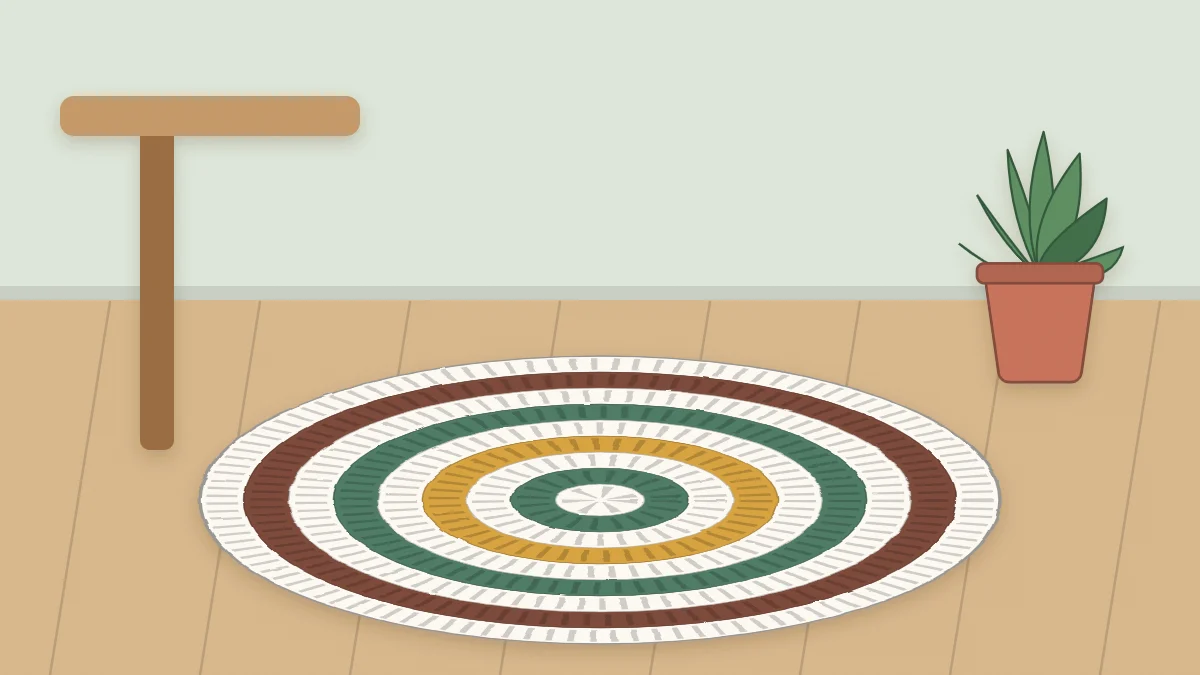
Thick yarn and a large hook turn a crochet round rug into a weekend project, not a month-long one. This pattern makes a 30 in (76 cm) rug in single crochet using t-shirt yarn or thick cotton cord, and the real skill it teaches is keeping a big circle flat from the center to the last round.
Materials and yarn choice
- T-shirt yarn or thick cotton cord of about 5 mm: roughly 200 to 260 yards (183 to 238 m)
- N/P-15 (10 mm) crochet hook
- Locking stitch marker
- Non-slip rug pad, cut to a circle of about 28 in (71 cm)
- Large-eye yarn needle or a smaller hook for the tails, and sharp scissors
T-shirt yarn is a stretchy jersey strip. It is soft underfoot and builds a thick, cushioned rug, but its thickness can vary from one cone to the next, so yardage is only an estimate. Cotton cord is firmer, more even and gives sharper stitch definition. Either works here; the fiber guide in best yarn for crochet home decor covers how each one behaves on the floor.
Gauge and finished size
Gauge: Rounds 1 to 5 measure about 6 in (15 cm) across, so each round adds about 0.6 in (1.5 cm) to the radius, or 1.2 in (3 cm) to the diameter. Twenty-five rounds give 25 x 1.2 = 30 in.
If your first five rounds measure 5 in (13 cm), you will need about 30 rounds to reach the same size. If they measure 7 in (18 cm), stop at about 21. The pattern is the same either way: keep adding rounds until the rug is as wide as you want.
Stitch abbreviations (US terms)
- MR: magic ring
- sc: single crochet
- inc: 2 sc in the same stitch
- st/sts: stitch/stitches
- sl st: slip stitch
Round rug pattern
The rug is worked in a continuous spiral without joining. Move the marker up to the first stitch of every round. The flat-circle rule is simple: start with 6 sc and add 6 stitches in every round. It is the same rule used at a much smaller scale for easy crochet coasters.
- Round 1: Make a MR and work 6 sc into it. Pull the ring closed. (6)
- Round 2: Inc in each st around. (12)
- Round 3: (Sc 1, inc) 6 times. (18)
- Round 4: Sc 1, inc, (sc 2, inc) 5 times, sc 1. (24)
- Round 5: (Sc 3, inc) 6 times. (30)
- Round 6: Sc 2, inc, (sc 4, inc) 5 times, sc 2. (36)
- Round 7: (Sc 5, inc) 6 times. (42)
- Round 8: Sc 3, inc, (sc 6, inc) 5 times, sc 3. (48)
- Rounds 9 to 25: Continue in the same way, adding 6 sts per round. On odd rounds, work the plain stitches and then the inc, 6 times. On even rounds, work half of the plain stitches first, then inc, then 5 full repeats, and finish with the other half. The number of plain stitches between increases is always the round number minus 2, so Round 9 has 7 and Round 25 has 23. (150 sts after Round 25)
- Finish: Sl st in each of the next 2 sts to smooth the step at the end of the spiral. Fasten off, leaving a 6 in (15 cm) tail.
Shifting the increases on even rounds stops them stacking on top of each other. Stacked increases give you a hexagon with six soft corners, not a true circle.
| After round | Stitch count | Approx. diameter |
|---|---|---|
| 5 | 30 | 6 in (15 cm) |
| 10 | 60 | 12 in (30 cm) |
| 15 | 90 | 18 in (46 cm) |
| 20 | 120 | 24 in (61 cm) |
| 25 | 150 | 30 in (76 cm) |
The stitch count for any round is the round number times 6, which makes it easy to check your work without counting from the center.
Fixing ruffles and cupping
Lay the rug on a hard floor every three or four rounds and look at the edge. Thick yarn exaggerates small errors, and a problem is far easier to correct two rounds back than ten.
The edge ruffles or waves
There are more stitches than the circumference can hold. This happens when your stitches are short and wide, or when an extra increase slipped in. Rip back to where the rug lay flat, work one round with no increases at all, then carry on with the normal sequence. If it ruffles again, repeat the plain round every fifth or sixth round, or switch to a hook one size smaller.
The edge cups into a bowl
There are too few stitches, usually because of tight tension or a missed increase. Rip back to the last flat round and work one round with 12 increases, evenly spaced, in place of 6. A larger hook also helps. Stretchy t-shirt yarn cups easily if you pull it taut, so let it feed loosely.
Once you add or skip increases, your counts will no longer match the table. That is fine: from that point, flatness is the guide and the numbers are only a reference.
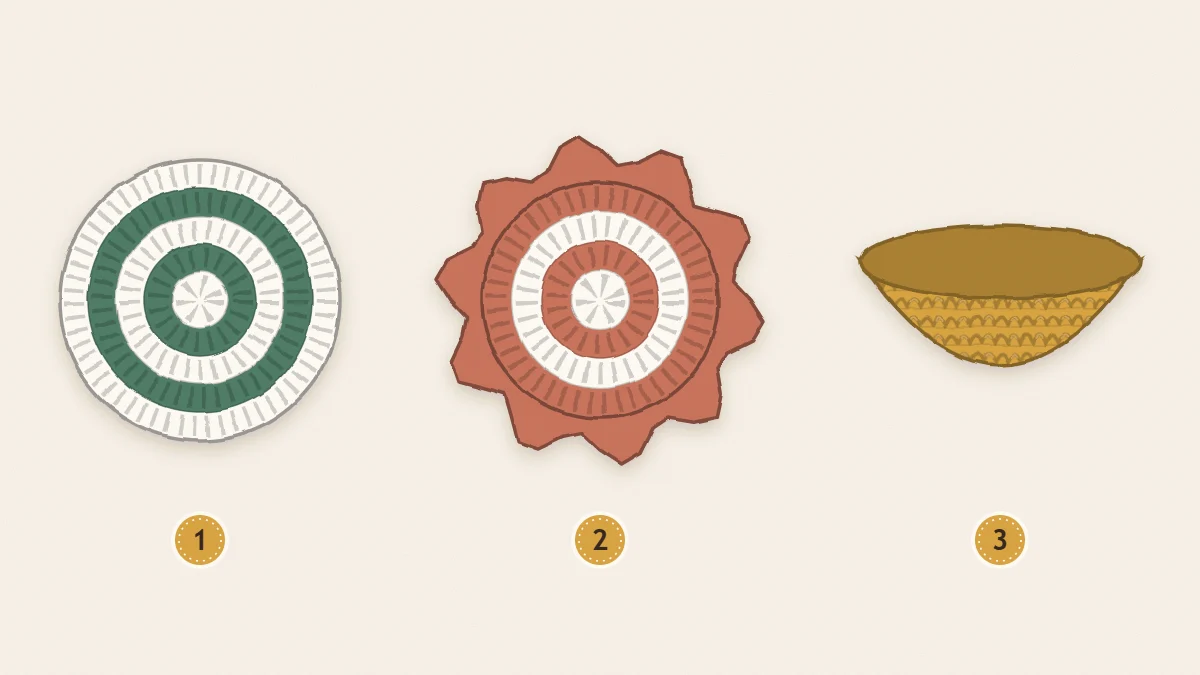
Finishing and the non-slip pad
Thick tails are too bulky for most needles. Pull each tail under the back of six or seven stitches with a smaller hook, turn back for three stitches, and trim close. Then lay the rug flat, smooth it from the center outward, and let it rest overnight. Cotton cord benefits from a light mist of water first; the methods are compared in finishing crochet home decor.
Watch out
A crochet rug slides easily on wood, tile and laminate. Always lay it over a non-slip rug pad cut slightly smaller than the rug, and keep it away from the top of stairs.
Care
Shake the rug outdoors and vacuum it with a brush-free head. For spills, blot and spot clean with mild soap. If the label on your yarn allows washing, use a cool, gentle cycle. A wet rug is very heavy, so support it from underneath, reshape it into a circle and dry it flat. Hanging it will pull it into an oval.
Any leftover yarn is ideal for a matching crochet storage basket, which starts with the same flat circle before the sides turn upward.
Frequently asked questions
Can I make the rug bigger than 30 inches?
Yes. Keep adding rounds with 6 increases each until the rug reaches the size you want. Every round adds about 1.2 in (3 cm) to the diameter at the stated gauge, so a 36 in rug needs about 30 rounds. Yarn use climbs quickly on the outer rounds, so allow plenty of extra.
Should I join each round or work in a spiral?
A continuous spiral avoids the visible seam line that joined rounds leave across a rug. The only drawback is a small step at the very end, which two slip stitches smooth out. Use a stitch marker so you always know where a round begins.
How do I join a new ball of thick yarn?
Finish the last stitch of the old yarn with the new yarn by pulling the new strand through the final two loops. Leave tails of about 6 in (15 cm) and weave each one in a different direction on the underside so the join does not form a lump.