Crochet Potholder: The Classic Double-Thick Cotton Pattern
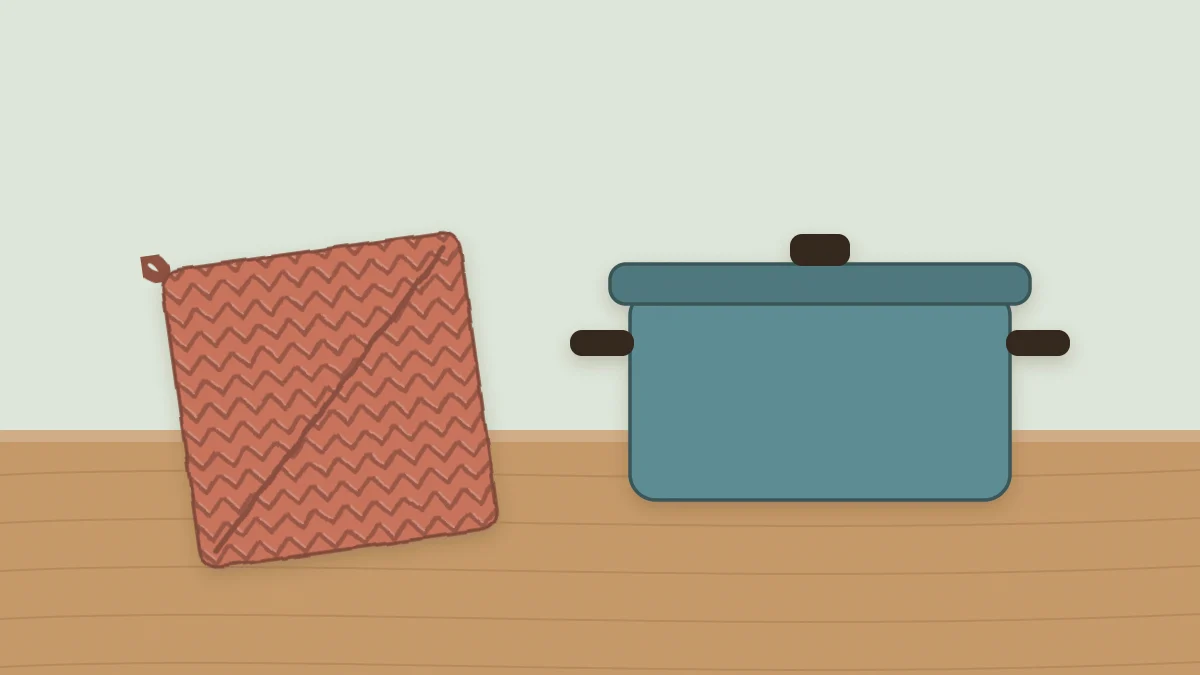
Work single crochet in a spiral around a foundation chain, fold the pouch on the diagonal and seam it into a double-thick 7 in cotton potholder with a hanging loop.
Project at a glance
Materials
- About 75 to 90 yd (69 to 82 m) worsted-weight 100% cotton
- G-6 (4 mm) crochet hook
- Stitch marker
- Yarn needle
- Scissors
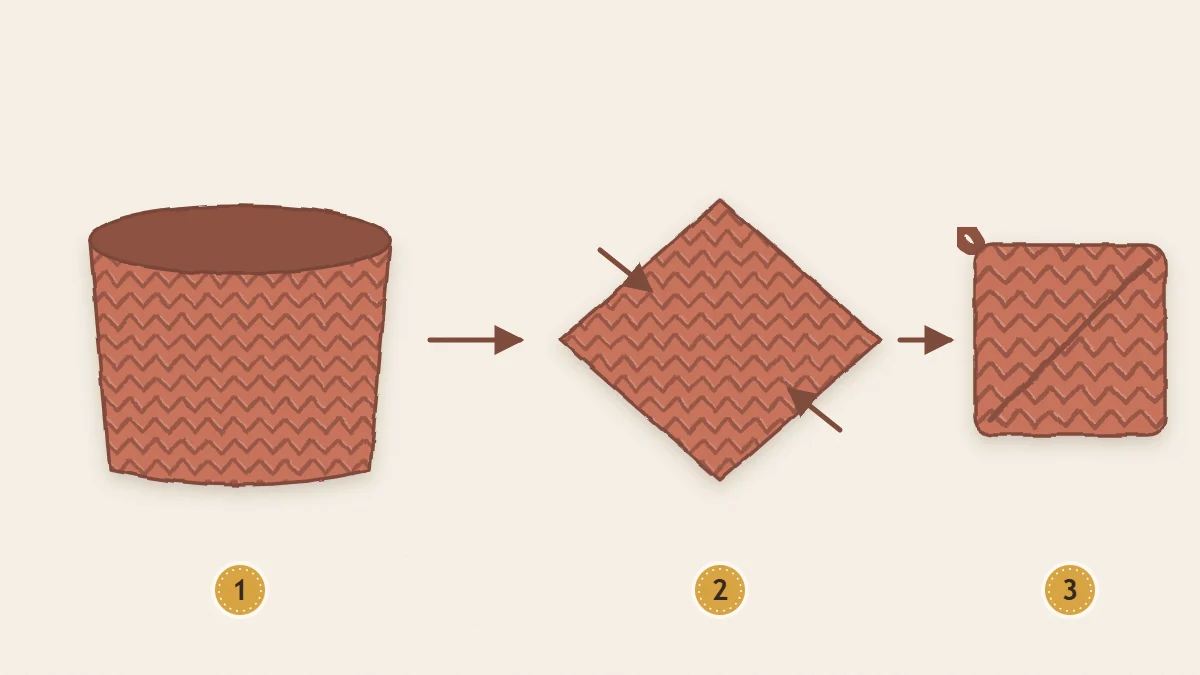
The classic double-thick crochet potholder looks like clever engineering, but it is only single crochet worked in a spiral around a foundation chain. The fabric forms a pouch that folds flat on the diagonal into a square with two full layers of cotton between your hand and the pan. This one finishes at about 7 in (18 cm) square.
Why the yarn must be 100% cotton
Fiber choice is a safety matter here, not a matter of taste. Acrylic and other synthetic yarns can melt when they touch a hot pan or oven rack, and melted fiber sticks to skin. Cotton does not melt, which is why it is the standard fiber for anything that handles heat. Wool also resists heat well, but cotton is easier to wash.
Watch out
Check the label for 100% cotton. Blends that contain acrylic, polyester or nylon are not suitable. Never use a damp potholder either: water carries heat straight through the fabric.
The broader fiber comparison is in best yarn for crochet home decor.
Materials
- Worsted-weight (#4) 100% cotton: roughly 75 to 90 yards (69 to 82 m)
- G-6 (4 mm) crochet hook
- Stitch marker
- Yarn needle and scissors
The hook is smaller than the usual choice for worsted yarn on purpose. Tight stitches leave no gaps for heat to pass through.
Gauge and how the size works
Gauge: 16 sc and 18 rounds = 4 in (10 cm), which is 4 stitches and 4.5 rounds per inch. The fabric should feel stiff.
The geometry is worth understanding because it lets you make any size. The foundation chain becomes one diagonal of the finished square. A chain of 40 stitches at 4 per inch is 10 in long, and a square with a 10 in diagonal has sides of about 7 in. The pouch is ready to fold when its height equals half the chain length: 5 in here, or about 22 rounds.
| Foundation chain | Stitches per round | Rounds (approx.) | Finished square |
|---|---|---|---|
| 35 | 68 | 19 | 6 in (15 cm) |
| 41 | 80 | 22 | 7 in (18 cm) |
| 47 | 92 | 26 | 8 in (20 cm) |
Stitch abbreviations (US terms)
- ch: chain
- sc: single crochet
- sl st: slip stitch
- st/sts: stitch/stitches
Potholder pattern
Work the pouch
- Foundation: Ch 41.
- Round 1: Sc in the 2nd ch from the hook and in each ch across (40 sc). Do not turn. Rotate the piece so the underside of the chain is on top, and sc in the unused loop of each ch back to the start (40 sc). (80 sc)
- Round 2: Without joining, sc in the first sc of Round 1 and place the marker in the stitch just made. Sc in each remaining st around. (80 sc)
- Rounds 3 to 22: Sc in each st around in a continuous spiral, moving the marker up to the first st of every round. (80 sc per round)
There are no increases, so the two ends of the chain pull upward after a few rounds and the piece turns into a boat shape, then a pouch. That is exactly what should happen.
Fold on the diagonal
- Test the fold: Hold the pouch with the foundation chain along the bottom. Take the middle of the front edge in one hand and the middle of the back edge in the other, and pull them apart. The opening closes into a straight line that crosses the foundation chain at a right angle, and the pouch flattens into a square.
- Check the fit: If the two edges meet without a gap and the square lies flat, the pouch is the right height. If a gap remains, add one more round and test again. If the edges overlap and the square buckles, remove a round.
- Set up the seam: After Round 22, sc in the marked st and in each of the next 19 sts (20 sc). This places your hook at the middle of one side, which is a corner of the finished square.
Seam and hanging loop
- Seam: Flatten the pouch as in the fold test, with the hook at one corner. The opening now has 40 sts on each side of the seam line. Insert the hook through both layers and sl st in each pair of sts across. (40 sl sts)
- Hanging loop: At the far corner, ch 10 and sl st into the last seam st to form a loop. For a sturdier loop, turn and work 12 sc around the chain, then sl st to the corner again.
- Finish: Fasten off, leaving an 8 in (20 cm) tail.
Whipstitching the opening closed with a yarn needle gives a flatter seam if you prefer it to slip stitch.
Finishing
Thread each tail onto the yarn needle and run it between the two layers for about 3 in (8 cm), where it is completely hidden and cannot work free. The starting tail at the foundation chain goes inside the same way. Tug the four corners to square the piece. Blocking is optional for something this thick; if the square leans, the methods in finishing crochet home decor will straighten it.
Use and care
Two layers of tight cotton are meant for the brief job of moving a hot pan or lifting a lid. For a long hold, or for cookware straight out of a very hot oven, use two potholders stacked or a padded oven mitt, and replace any potholder that has worn thin or developed holes.
Cotton can generally be machine washed; follow your yarn label and dry the potholder fully before using it again. Expect some shrinkage on the first wash, which only makes the fabric denser.
The same cotton makes a matching set of crochet dishcloths. If spiral rounds are new to you, crochet home decor for beginners walks through the basic stitches first.
Frequently asked questions
Why did my potholder come out as a rectangle or refuse to lie flat?
The pouch was seamed at the wrong height. It folds into a true square only when its height is half the length of the foundation chain. Undo the seam, add or remove a round, and repeat the fold test until the edges meet with no gap and no buckling.
Can I use cotton-blend yarn?
Not if the blend contains synthetic fiber. Acrylic, polyester and nylon can melt on contact with hot cookware. Use yarn labeled 100% cotton for anything that will touch heat.
Can I change colors for a striped potholder?
Yes. Because the piece is a spiral, stripes run parallel to the foundation chain and appear as diagonal bands on the finished square. Change color at the marker and hide the tails between the two layers.