Crochet Dishcloths: Three Quick Textured Cotton Patterns
Three 8 in cotton dishcloths in three textures: smooth moss stitch, pebbled lemon peel and ridged grit stitch. Includes the best cotton to use, a shared edging and care notes.
Project at a glance
Materials
- About 150 yd (137 m) worsted-weight 100% cotton for three cloths
- H-8 (5 mm) crochet hook
- Yarn needle
- Scissors
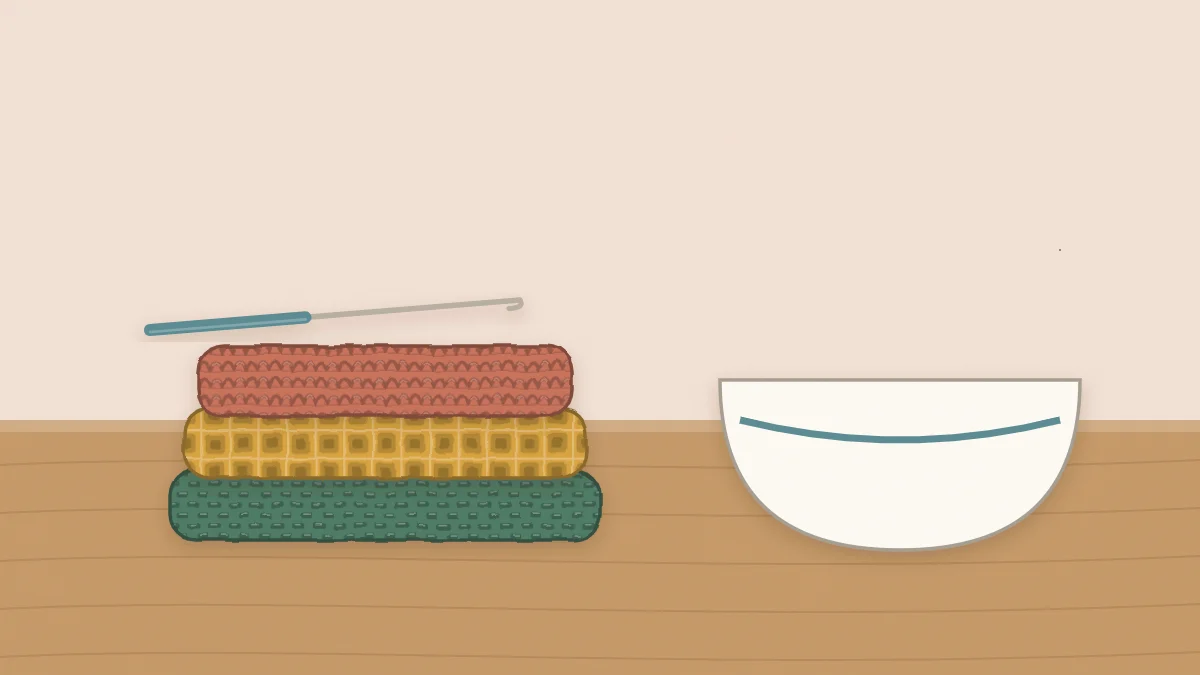
Three crochet dishcloths, three different textures, and each one is small enough to finish in a sitting. All of them measure about 8 in (20 cm) square in worsted cotton, and between them they cover the jobs a kitchen cloth has to do: wiping, scrubbing and drying.
The best cotton for dishcloths
Use 100% cotton in worsted weight (#4). Cotton absorbs water, tolerates hot water and frequent washing, and gets softer with use. Acrylic repels water, so it pushes a spill around without picking it up.
Within cotton, the spin matters. A matte, softly spun kitchen cotton is the most absorbent and the usual choice for a working cloth. A smooth mercerized cotton has more sheen and sharper stitch definition but soaks up less, so it suits a decorative cloth better than a working one. Medium and dark shades hide stains longer than white or cream.
Materials, gauge and size
- Worsted-weight (#4) 100% cotton: about 40 to 50 yards (37 to 46 m) per cloth, or about 150 yards (137 m) for all three
- H-8 (5 mm) crochet hook
- Yarn needle and scissors
Gauge: In moss stitch, 16 sts and 16 rows = 4 in (10 cm), counting each sc and each ch-1 sp as a stitch. In lemon peel and grit stitch, 14 sts and 14 rows = 4 in (10 cm).
Each cloth body is about 7.5 in (19 cm) square, and the edging adds about 0.25 in (6 mm) to every side to reach 8 in. Exact gauge is not critical for a dishcloth, but a firm fabric scrubs better and lasts longer than a loose one.
| Cloth | Foundation chain | Stitches per row | Rows | Best for |
|---|---|---|---|---|
| Moss stitch | 32 | 30 | 30 | Drying and wiping |
| Lemon peel | 27 | 26 | 26 | Everyday washing up |
| Grit stitch | 27 | 26 | 26 | Scrubbing |
Stitch abbreviations (US terms)
- ch: chain
- sc: single crochet
- dc: double crochet
- sk: skip
- sp: space
- st/sts: stitch/stitches
- sl st: slip stitch
- rep: repeat
Three dishcloth patterns
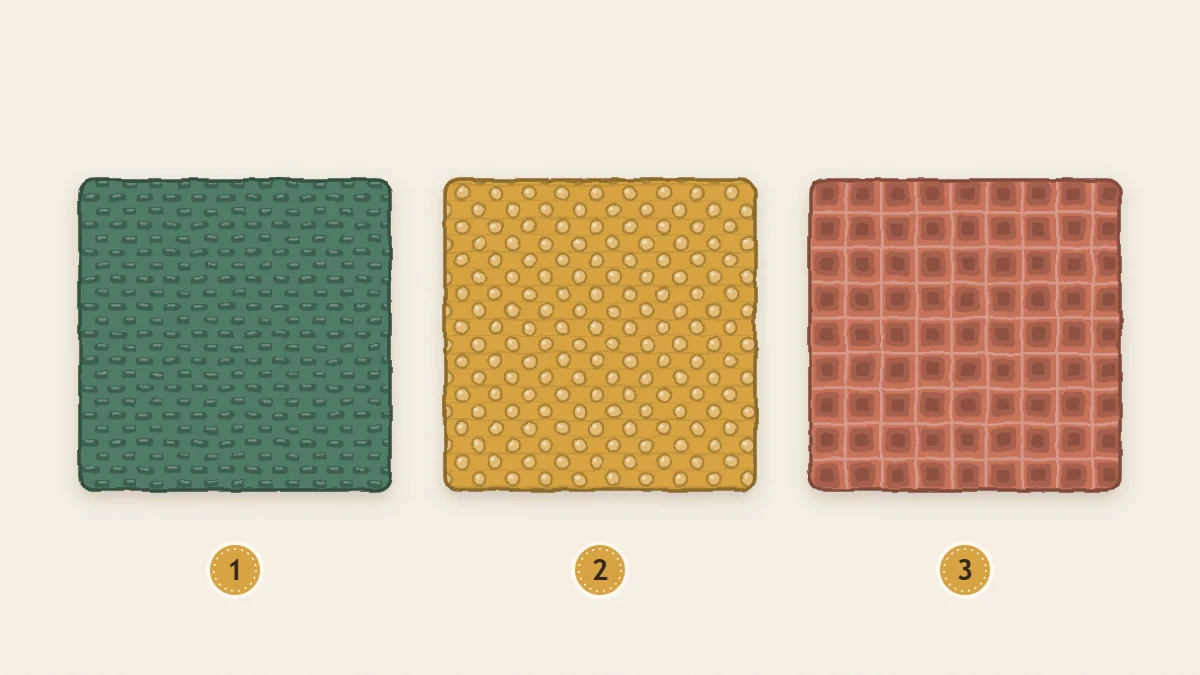
Cloth 1: moss stitch
Thin, flat and quick to dry. This is the smoothest of the three.
- Foundation: Ch 32.
- Row 1: Sc in the 4th ch from the hook. *Ch 1, sk 1 ch, sc in the next ch; rep from * to the end. (15 sc and 14 ch-1 sps)
- Row 2: Ch 2, turn. Sc in the first ch-1 sp. *Ch 1, sc in the next ch-1 sp; rep from * across, working the last sc into the turning-chain sp. (15 sc and 14 ch-1 sps)
- Rows 3 to 30: Rep Row 2. Do not fasten off.
The turning chain counts as a stitch, so each row is 30 stitches wide: 15 sc, 14 chain spaces and the turning chain.
Cloth 2: lemon peel stitch
Short and tall stitches alternate and swap places every row, giving a soft pebbled surface on both sides.
- Foundation: Ch 27.
- Row 1: Sc in the 2nd ch from the hook, dc in the next ch. *Sc in the next ch, dc in the next ch; rep from * to the end. (26 sts)
- Row 2: Ch 1, turn. *Sc in the next dc, dc in the next sc; rep from * across. (26 sts)
- Rows 3 to 26: Rep Row 2. Do not fasten off.
Every row begins with a sc and ends with a dc. If you find yourself working a sc into a sc, a stitch has been skipped.
Cloth 3: grit stitch
Pairs of stitches lean to one side and form firm diagonal ridges, which makes this the roughest and best scrubbing cloth.
- Foundation: Ch 27.
- Row 1: Sc in the 2nd ch from the hook. *Sk 1 ch, (sc, dc) in the next ch; rep from * 12 times in total. Sc in the last ch. (26 sts)
- Row 2: Ch 1, turn. Sc in the first st. *Sk the next dc, (sc, dc) in the next sc; rep from * 12 times in total. Sc in the last st. (26 sts)
- Rows 3 to 26: Rep Row 2. Do not fasten off.
Edging for all three
- Ch 1, turn. Sc in each st across the top (30 for moss stitch, counting chain spaces and the turning chain; 26 for the others), then ch 2 for the corner.
- Rotate and work 1 sc in each row end down the side, ch 2. Work the same number of sc along the foundation chain as along the top, ch 2. Work 1 sc in each row end up the second side, ch 2.
- Sl st to the first sc and fasten off. (120 sc for moss stitch, 104 sc for lemon peel and grit stitch)
Tip
To hang a cloth by the sink, ch 10 at the last corner of the edging before you join, and sl st back into the same corner space to make a loop.
Finishing
A dishcloth is wrung out, scrubbed with and washed hot, so the tails take more abuse than on any other piece. Weave each one through the back of the stitches for about 2 in (5 cm), then back in the opposite direction for 1 in (2.5 cm), splitting the plies of the yarn as you go. Blocking is not needed; the first wash evens out the stitches.
These three are a sample of what small squares can teach. More stitches with their multiples are in texture stitches for crochet home decor, and a dishcloth is a good place to try each one.
Care and how they wear
Rinse and wring a cloth after each use and hang it to dry fully, since a cloth left bunched and damp develops an odor quickly. Wash on a warm or hot cycle if your yarn label allows it, and keep bright colors separate for the first few washes because cotton dye can run.
Expect slight shrinkage in the first wash and gradual fading after that. Cotton softens and thins with months of use, and that is normal wear, not a flaw in the stitches. Replace a cloth when it stays stained or the fabric thins out. Rotating several helps them all last longer.
With cotton left over, the same yarn suits a crochet potholder, a set of crochet placemats or a few easy crochet coasters.
Frequently asked questions
Which of the three cloths is easiest for a first project?
Lemon peel is the simplest to read because every stitch goes into the top of a stitch, not into a space. Moss stitch is a close second once you can spot the chain spaces. Grit stitch involves skipping stitches, so it is best made third.
Can I make the dishcloths larger or smaller?
Yes. Moss stitch works on any even number of chains, and lemon peel and grit stitch work on any odd number of chains. Add or remove chains in pairs, then work rows until the piece is square.
How many dishcloths does one ball of cotton make?
It depends on the yardage on the label. At roughly 40 to 50 yards per cloth, a ball of about 120 yards makes two cloths with a little left over, and three cloths need about 150 yards.