Crochet Bedroom Accents: How to Choose Pieces for a Calm Room
A planning guide to crochet bedroom accents: how to pick three or four handmade pieces, balance texture, color and scale, and decide what to make first.
Project at a glance
Materials
- Tape measure
- Notebook or a quick room sketch
- Yarn in two neutrals and one accent color
- Hook to match your yarn for a test swatch
The most restful bedrooms tend to have a few handmade pieces, not a dozen. Choosing crochet bedroom accents is mostly a matter of editing: pick three or four items that share a palette, vary in texture and size, and each do a real job in the room. This guide walks through how to choose them and which one to make first.
Start With Three or Four Pieces
Crochet has a strong surface. Every stitch casts a small shadow, so a handmade piece draws the eye more than a plain woven fabric of the same color. A few pieces spread around the room look calm and deliberate. Many pieces crowded together start to compete, and the room feels busier than it is.
A good working number is three pieces for a small bedroom and four for a larger one. Choose them from different parts of the room, so that wherever you look there is one handmade detail and plenty of quiet space around it.
The Five Candidates
Almost every bedroom plan draws on the same five kinds of piece. You do not need all of them.
| Piece | Where it goes | What it adds | Effort |
|---|---|---|---|
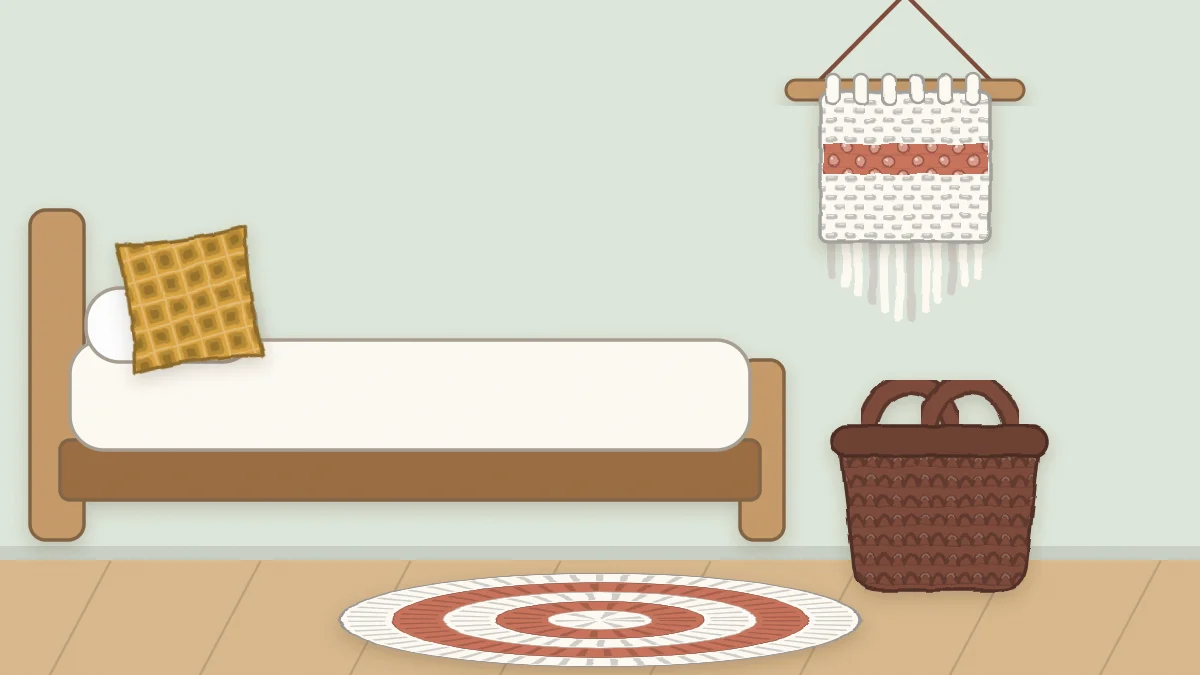
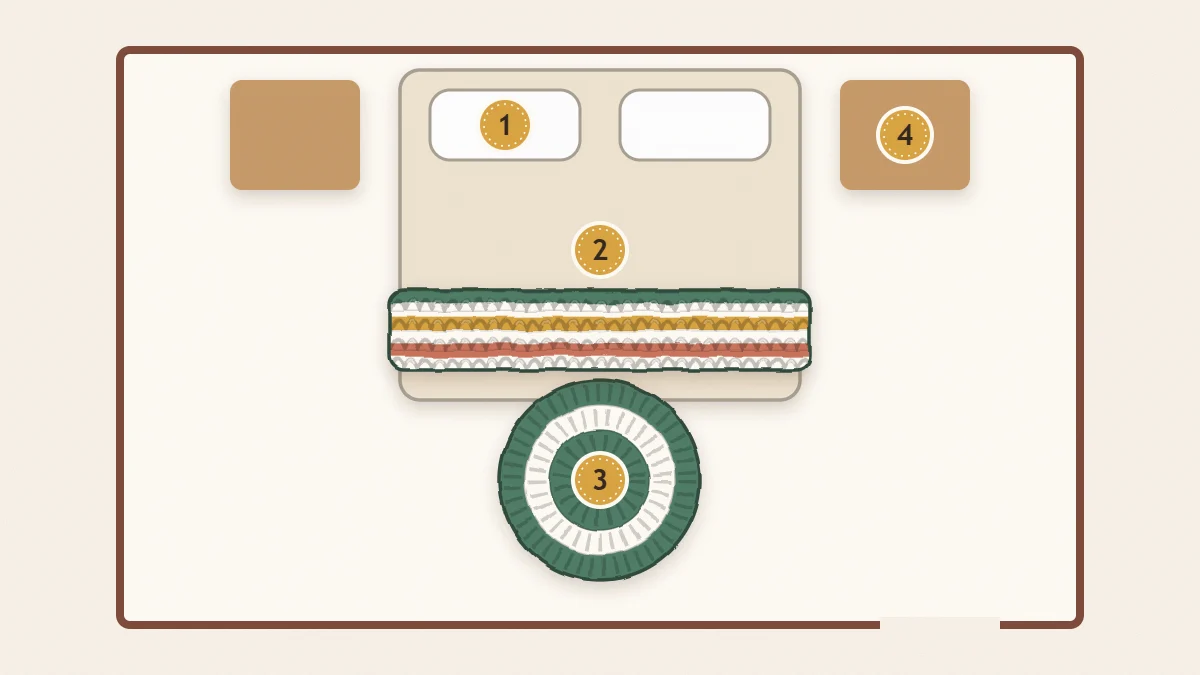
| Pillow cover | On the bed, in front of the sleeping pillows | Close-up texture | Low |
| Bed runner | Across the foot of the bed | The largest block of color | Medium to high |
| Basket | Nightstand, dresser or floor | Storage and structure | Low to medium |
| Wall piece | Above the headboard or beside it | Height and a focal point | Low |
| Bedside rug | On the floor where your feet land | Softness underfoot | Medium |
Notice that the list covers three levels: the floor, the bed and the wall. Picking at least one piece from each level is the simplest way to make a room feel balanced from top to bottom.
Balance Texture
Texture is where handmade rooms most often tip from calm into cluttered. A useful rule is one loud texture, the rest quiet.
- Loud textures: bobbles, deep waffle stitch, basketweave, long fringe.
- Quiet textures: half double crochet, moss stitch, plain single crochet, simple stripes.
Give the loud texture to the smallest piece. A bobbled pillow is a pleasure to look at, while a bobbled bed runner covering a third of the mattress can be overwhelming. Large pieces do better in a flat, even stitch that reads as a field of color from across the room.
Yarn thickness counts as texture too. Chunky stitches next to fine ones give contrast without adding another pattern, so a bulky runner and a worsted-weight pillow already look different enough.
Keep the Color Palette Short
Bedrooms are easier to settle into when the colors are few. Start with what is already there: the bedding, the wall color and the floor. Then choose two neutrals close to those and one accent color, and use only those three across every piece you make.
- Let the largest piece carry the neutrals.
- Put the accent in the smallest pieces, or in a single stripe of a larger one.
- Repeat the accent at least twice in the room, so it looks planned and not accidental.
Muted, low-contrast combinations such as oatmeal, soft gray and a dusty blue feel more restful than sharp pairings like black and white. If you want ready-made combinations and a way to test them with a swatch, see the guide to crochet color palettes for home decor.
Think About Scale and Layout
Scale means how big each piece is compared with the bed, which is always the largest thing in the room. The aim is a clear order of sizes, with one large, one or two medium and one small piece, and no two fighting for the same role.
- Large: the bed runner or the rug. Choose one of them as the anchor; having both is fine if they share a color.
- Medium: a wall piece. Over a headboard, something roughly half to two-thirds the width of the headboard looks settled. A small hanging is better placed to one side, above the nightstand.
- Small: a pillow or a basket. Odd numbers group well, so one accent pillow usually looks better than two matching ones.
Walk the room in your head. Standing in the doorway, what do you see first? That is the place for your favorite piece. Then check each remaining spot: the foot of the bed, the nightstand and the floor on the side where you get up. Leave at least one of these empty.
Watch out
A rug beside the bed is stepped on when you are half awake. Always lay it over a non-slip rug pad, and keep it clear of the swing of any door.
What to Make First
Begin with the piece that is quickest to finish and easiest to change your mind about. Seeing your colors in the room, in real light, tells you more than any plan.
- A pillow cover. It uses little yarn, tests your palette and can be finished in a weekend. The crochet throw pillow cover is a flat rectangle folded into an envelope, so there is no shaping to learn.
- A basket. It gives the nightstand a place for small things and introduces a firmer texture. The crochet storage basket stands up on its own.
- A wall piece. A small fringed panel on a dowel fills the space above the nightstand and takes only an evening or two.
- The anchor. Finish with the largest piece, once you are sure of the colors. A striped crochet bed runner can repeat every shade used in the smaller pieces and tie them together.
Working from small to large also protects you from the most common disappointment: finishing a big piece and discovering the color is wrong for the room.
Living With Handmade Pieces
A bedroom is a low-traffic room, which is kind to crochet, but a little care keeps the pieces looking fresh.
- Shake out or lightly vacuum textured pieces now and then; raised stitches hold dust.
- Keep strongly colored pieces out of direct sun where you can, since many dyes fade over time.
- Follow the care instructions on the yarn label, and keep a label from each project so you can check it later.
- Swap a pillow cover or a small wall piece with the seasons instead of adding more. The count stays at three or four and the room still feels new.
Frequently asked questions
How many crochet pieces are too many for a bedroom?
There is no fixed limit, but most bedrooms start to look busy beyond four or five visible pieces. If you love making more, rotate them through the room by season and store the rest.
Do all the crochet pieces in a bedroom need to match?
No. They should share a short color palette, but varying the stitch and yarn thickness makes the room more interesting. Identical pieces in the same stitch can look like a bought set.
What is the best crochet piece for a very small bedroom?
A wall piece or a single pillow cover. Both add texture without using floor or surface space, and neither makes the room feel more crowded.