Crochet Home Decor for Beginners: Stitches, Kit and First Projects
A starting guide to crochet home decor: why flat pieces are easier than garments, the five stitches to learn, a short starter kit and the best order for your first four projects.
Project at a glance
Materials
- Smooth light-colored #4 worsted cotton or acrylic
- H-8 (5 mm) hook
- Blunt yarn needle
- Small scissors
- Tape measure
- Locking stitch markers
Crochet home decor for beginners is the kindest place to start learning, because a coaster does not have to fit anyone. Flat squares, circles and rectangles forgive uneven tension, finish in an evening or two, and get used every day. This guide covers the stitches you need, a short starter kit and a sensible order for your first four projects.
Why Decor Is Easier Than Garments
A sweater has to match a body, so shaping, drape, sleeve length and fit all matter at once. Home pieces mostly need to lie flat and land near the right size. If a dishcloth comes out half an inch (1.3 cm) wider than planned, it still dries dishes.
- Simple shapes. Most decor is a square, a rectangle, a circle or a tube, so you practice one skill at a time.
- Firm fabric is welcome. New crocheters tend to work tightly. Tight stitches spoil a drapey top, but they are exactly what a basket or coaster needs.
- Small yardage. A coaster uses roughly 20 to 25 yards (18 to 23 m), so a mistake sets you back minutes rather than days.
- Fast feedback. You see a finished object quickly, which makes it easier to notice what to change on the next one.
The Five Stitches You Need
Almost every beginner decor pattern is built from five basic stitches. Patterns on this site use US terms. UK patterns give the same stitches different names (a US single crochet is a UK double crochet), so check which system a pattern uses before you begin.
| Stitch | Abbreviation | What it does |
|---|---|---|
| Chain | ch | Starts a project and adds height at the beginning of a row |
| Slip stitch | sl st | Joins rounds and moves the yarn along without adding height |
| Single crochet | sc | Short and dense; the backbone of coasters, baskets and trays |
| Half double crochet | hdc | Medium height with a soft, slightly squishy feel; good for pillows and blankets |
| Double crochet | dc | Tall and quick to grow; used for throws, runners and flat circles |
Practice on a small swatch before starting a project. Chain 16, work 1 sc in the 2nd ch from the hook and in each ch across (15 sc), then ch 1, turn and repeat for 10 rows. Count at the end of every row. If the number stays at 15, your edges will stay straight. Losing or gaining a stitch at the row ends is the most common early problem, and counting is the cure.
A Simple Starter Kit
You need very little to begin, and all of it fits in a small pouch.
- One or two balls of smooth, light-colored #4 worsted (medium) cotton or acrylic. A pale, smooth yarn shows each stitch clearly; dark, fuzzy or novelty yarn hides them.
- An H-8 (5 mm) hook, the usual partner for worsted yarn.
- A blunt yarn needle for weaving in ends.
- Small, sharp scissors.
- A tape measure.
- A few locking stitch markers to flag the first stitch of a round.
Fiber matters more as your projects get more specific. Cotton is absorbent and crisp, acrylic is light and soft, and thick cord makes the sturdiest baskets. The guide to the best yarn for crochet home decor matches each fiber to the room it suits.
Watch out
Anything that touches a hot pan, such as a potholder, hot pad or trivet, must be 100% cotton or wool. Acrylic can melt under heat, so keep it for pillows, throws and wall pieces.
Your First Four Projects, in Order
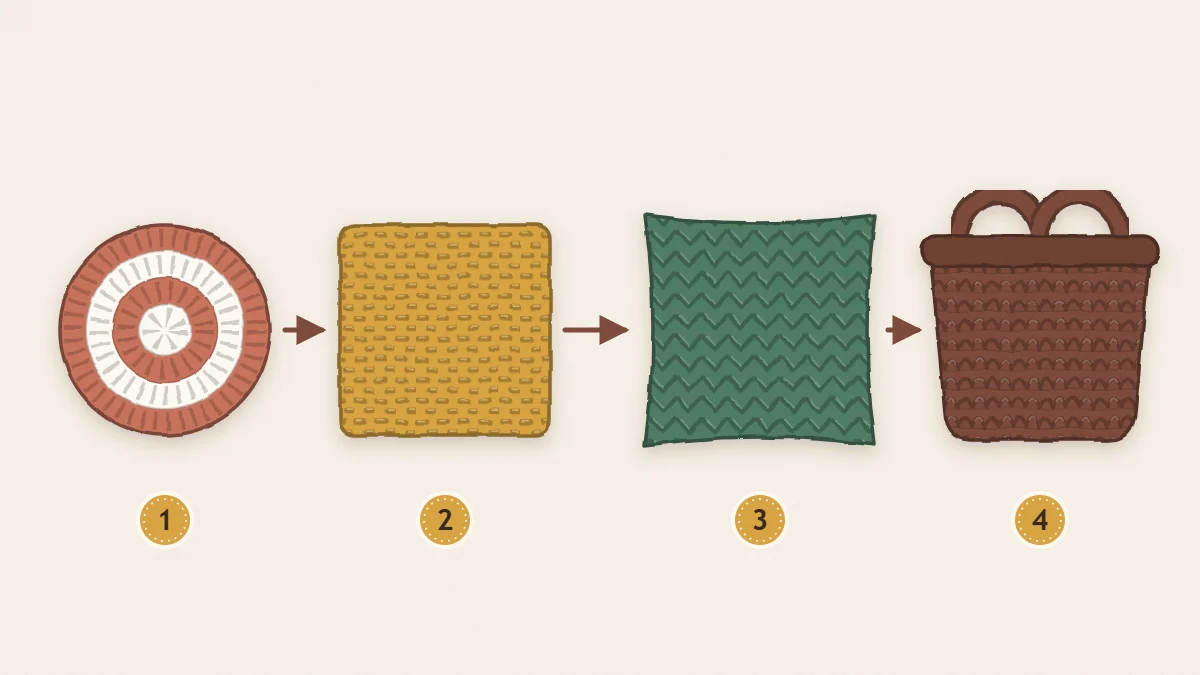
Each of these projects adds one new skill to the ones before it, so nothing arrives all at once.
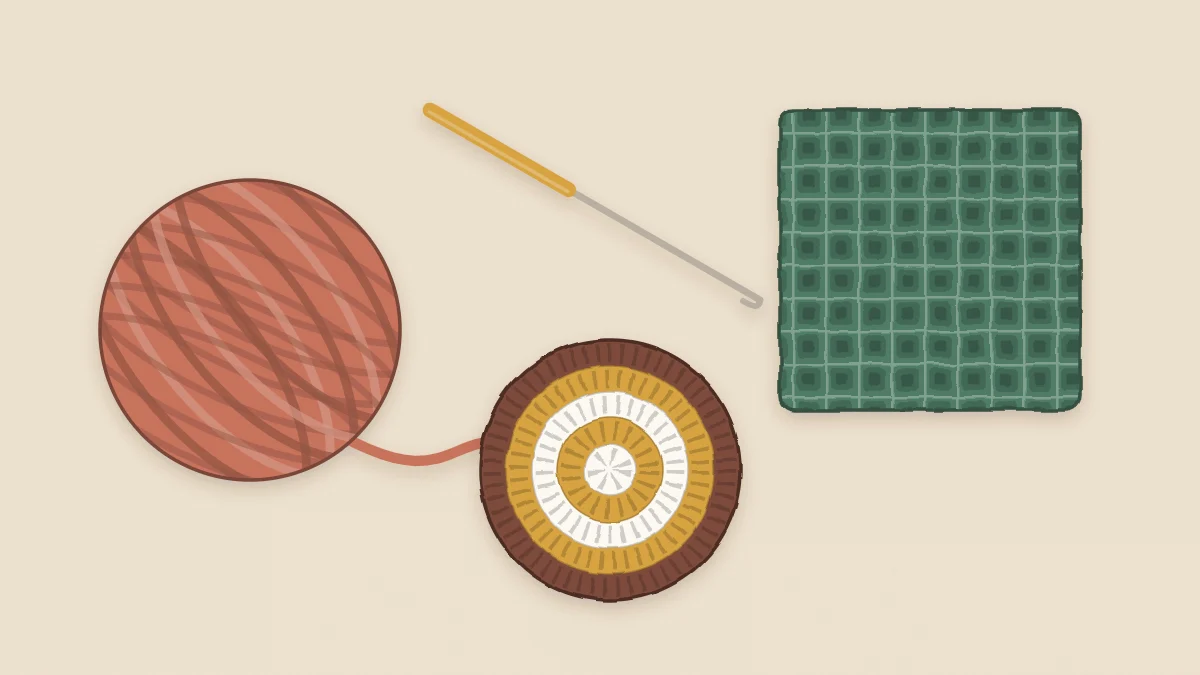
- Coasters. A small circle teaches working in the round, joining with a sl st and increasing evenly so the piece stays flat. A set of easy crochet coasters gives you four chances to practice the same rounds.
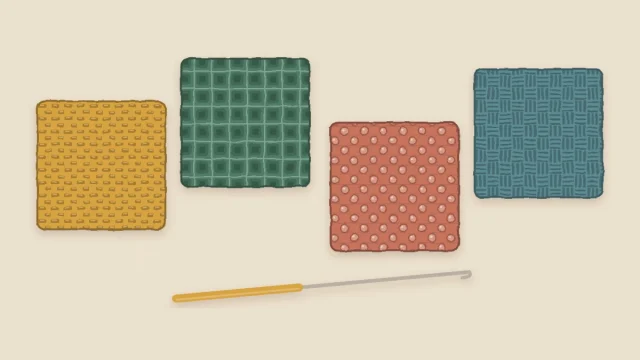
- A dishcloth. An 8 in (20 cm) square teaches turning rows, straight edges and a first textured stitch. Cotton crochet dishcloths are useful even when the edges wobble.
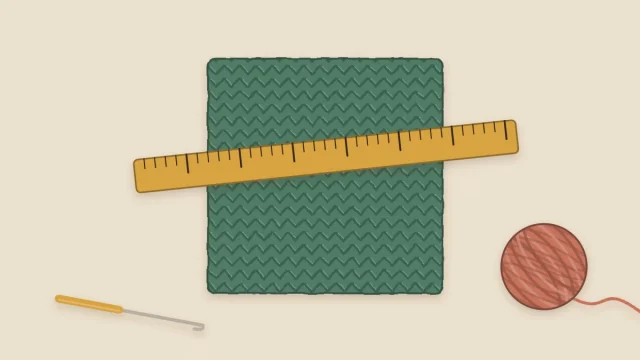
- A pillow cover. This is the same rectangle skill at a larger scale, plus measuring, a gauge swatch and a simple seam. It is your first piece that has to fit something.
- A basket. A flat circle becomes a base, then the sides rise without increases. A crochet storage basket introduces continuous rounds and a deliberately stiff fabric.
Move on when the current project feels routine rather than when it looks perfect. Two or three coasters are usually enough before the dishcloth, and the pillow cover feels far less daunting once straight rows are automatic.
How to Read a Beginner Pattern
Written patterns follow a few shared conventions, and knowing them removes most of the confusion.
- Numbers in parentheses at the end of a row or round are the stitch count you should have, for example (18 sc). Check it every time.
- Asterisks mark a repeat: “*sc in next st, ch 1; rep from * across” means to work that pair again and again to the end.
- Turning chains lift the yarn to the height of the next row: ch 1 for sc, ch 2 for hdc, ch 3 for dc. The pattern says whether the chain counts as a stitch.
- Gauge is the number of stitches and rows in 4 in (10 cm). It barely matters for a coaster and matters a great deal for a pillow cover.
Habits That Make Early Projects Look Better
A few small habits do more for the finished look than any special tool.
- Work the foundation chain loosely, or use a hook one size larger for it, so the bottom edge does not pull in.
- Insert the hook under both top loops of a stitch unless the pattern says BLO or FLO.
- Mark the first stitch of each round so you know exactly where the round ends.
- Leave yarn tails about 6 in (15 cm) long and weave them in with a needle instead of knotting and trimming.
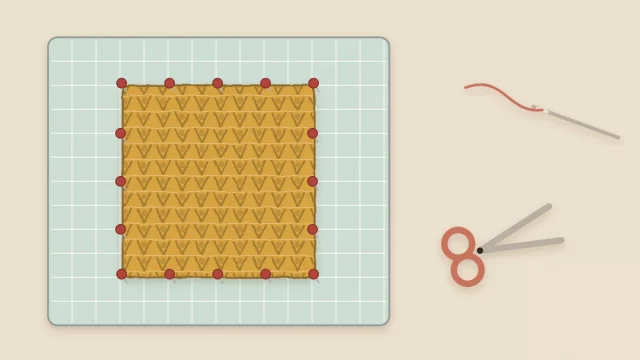
- Pin square and rectangular pieces to shape and let them dry flat; it straightens edges and evens out the stitches.
Keep your first swatch. Set it beside your fourth project and the improvement in your tension will be easy to see.
Frequently asked questions
Is cotton or acrylic better for learning to crochet?
Both work. Cotton has very little stretch, so stitches are crisp and easy to see, but it can feel stiff on the hands. Acrylic glides more easily and is lighter. Pick whichever is smooth and pale, and avoid acrylic for anything that touches heat.
Why does my flat piece keep getting narrower?
You are almost certainly missing the last stitch of the row, which hides beside the turning chain. Count every row and place a stitch marker in the first stitch you make so you know where the row must end on the way back.
How tightly should I hold the yarn?
Firmly enough that the stitches are even, loosely enough that the hook slides into them without forcing. If you have to wiggle the hook to get it in, relax your grip or go up one hook size.