Crochet Bed Runner in Wide Stripes for Any Bed Size
A wide-stripe crochet bed runner in bulky yarn and half double crochet, with a size table for twin, full, queen and king beds and tips for a neat drape.
Project at a glance
Materials
- #5 bulky yarn in two colors, about 780 yd (713 m) total for a queen
- K-10.5 (6.5 mm) crochet hook
- Large-eye yarn needle
- Locking stitch markers
- Scissors and tape measure
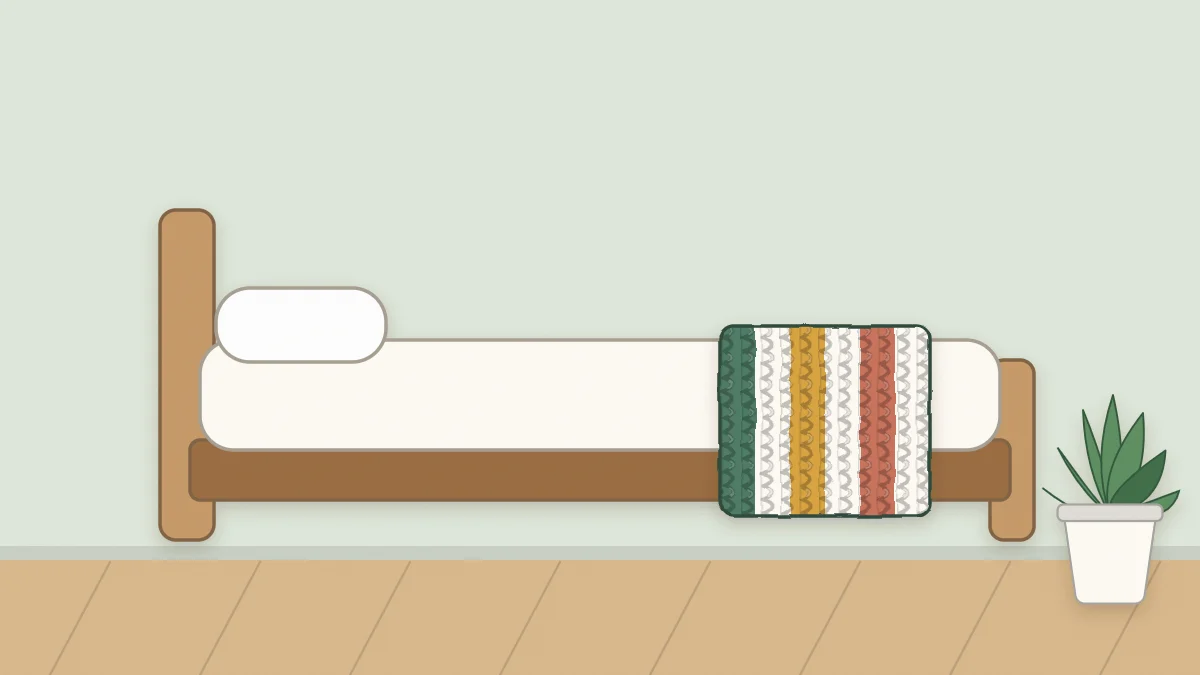
A crochet bed runner is a long, narrow strip laid across the foot of the bed, and it is one of the quickest ways to add handmade color to a bedroom without committing to a full blanket. This version uses bulky yarn, half double crochet and wide two-color stripes, so the only skills you need are a chain, one stitch and a clean color change.
Bed Runner Sizes for Every Mattress
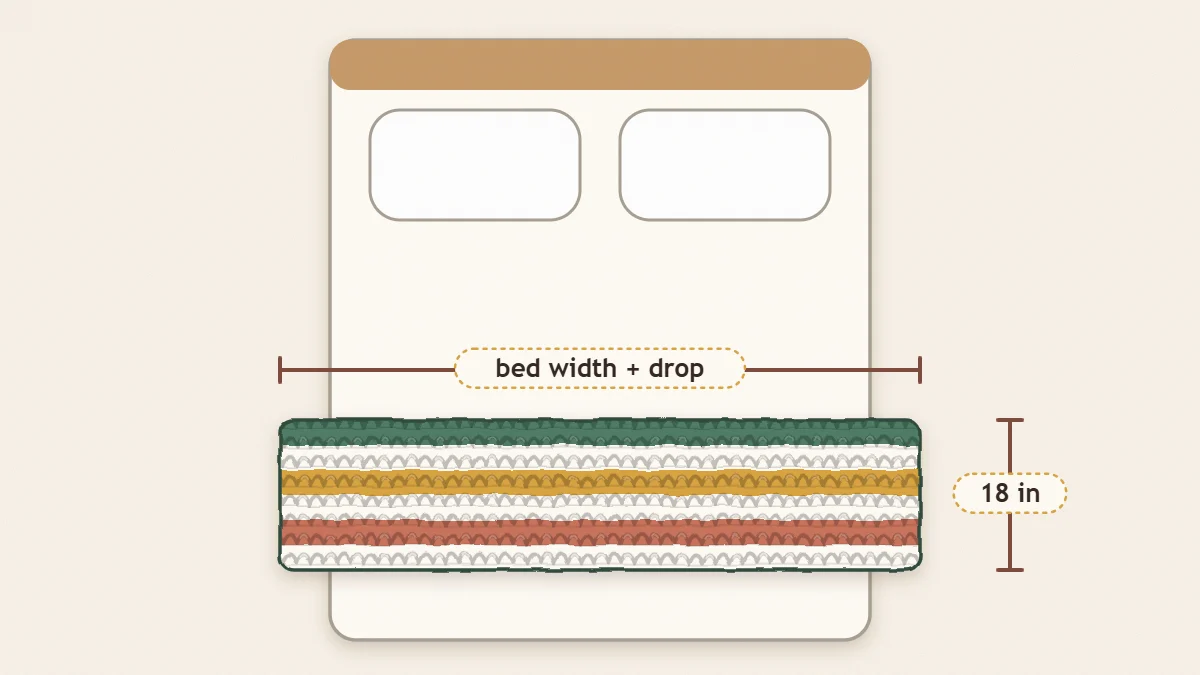
A runner (sometimes called a bed scarf) should be longer than the mattress is wide, so that it hangs down a little on both sides instead of stopping short at the edge. An overhang of 6 to 9 in (15 to 23 cm) per side looks intentional and keeps the piece from sliding around. The width, measured from the foot of the bed toward the pillows, is usually 18 to 24 in (46 to 61 cm); this pattern uses 20 in (51 cm) for every size.
| Bed | Mattress width | Runner size | Stripes | Total rows | Yarn (approx.) |
|---|---|---|---|---|---|
| Twin | 38 in (97 cm) | 20 x 54 in (51 x 137 cm) | 9 | 108 | 540 yd (494 m) |
| Full | 54 in (137 cm) | 20 x 66 in (51 x 168 cm) | 11 | 132 | 660 yd (604 m) |
| Queen | 60 in (152 cm) | 20 x 78 in (51 x 198 cm) | 13 | 156 | 780 yd (713 m) |
| King | 76 in (193 cm) | 20 x 90 in (51 x 229 cm) | 15 | 180 | 900 yd (823 m) |
Every size has an odd number of stripes, so the runner begins and ends with the same color. Mattresses vary, so measure yours before you start; the guide to sizing crochet home decor explains how to turn any measurement into a row count.
Yarn, Hook and Materials
Bulky yarn gives a runner enough body to lie flat on top of a duvet while still working up fast. A soft acrylic or a wool blend both suit a piece that sits on a bed; check the ball band for care instructions before you buy, because a runner picks up dust and needs cleaning now and then.
- #5 bulky yarn in two colors, A and B (totals in the table above)
- K-10.5 (6.5 mm) crochet hook
- Large-eye yarn needle
- Scissors and a tape measure
- Locking stitch markers for counting rows
Each stripe takes roughly 60 yd (55 m). Color A is used for one more stripe than color B, so split the total accordingly: for the queen size, that is about 420 yd (384 m) of A and 360 yd (329 m) of B. Two close shades give a quiet look, and a light neutral with one deeper color reads as a bold band; there is more help in the guide to color palettes for home decor.
Gauge and Abbreviations
Gauge: 10 hdc and 8 rows = 4 in (10 cm). That works out to 2.5 stitches and 2 rows per inch, so 50 stitches make the 20 in width and 12 rows make one 6 in (15 cm) stripe. Gauge matters here: if your rows are shorter, the runner may not reach both sides of the bed.
- ch = chain
- hdc = half double crochet
- sc = single crochet
- st/sts = stitch/stitches
- yo = yarn over
Wide-Stripe Bed Runner Pattern
The runner is worked in short rows across its 20 in width, and the stripes build up along its length. The turning chain does not count as a stitch.
- Row 1: With A, ch 51. Hdc in the 2nd ch from the hook and in each ch across (50 hdc).
- Rows 2 to 12: Ch 1, turn, hdc in each st across (50 hdc). On the last st of Row 12, work the final yo with B to change color. Cut A, leaving a 6 in (15 cm) tail.
- Rows 13 to 24: With B, ch 1, turn, hdc in each st across (50 hdc). Change to A in the last yo of Row 24 and cut B.
- Remaining stripes: Repeat the two 12-row stripes, alternating A and B, until you have the number of stripes listed for your bed: 9 for twin (108 rows), 11 for full (132 rows), 13 for queen (156 rows) or 15 for king (180 rows). The last stripe is worked in A.
- Fasten off, leaving a tail to weave in.
Tip
Clip a locking marker into the first row of each stripe. Counting 12 rows up from a marker is far easier than counting from the start chain once the runner is five feet long.
Edging and Finishing
A single round of sc squares up the stripe edges and hides the color changes along the sides. Join A in any corner and work as follows:
- Along each short end, sc in each st (50 sc).
- Along each long side, work 3 sc for every 2 rows, which is 18 sc per stripe.
- Work 3 sc in each corner. Join with a slip stitch to the first sc and fasten off.
If the long edge ripples, you are adding too many stitches; if it pulls in, add a few more. Weave each tail into its own color for at least 2 in (5 cm), changing direction once so it cannot work loose. A light steam or spray block evens out the rows, but match the method to your fiber: the guide to finishing crochet home decor covers which fibers can take steam and which cannot.
Getting a Good Drape
Half double crochet in bulky yarn makes a fabric that is soft but not floppy, which is what you want in a piece that has to hang neatly over the mattress edge. If your fabric feels stiff, go up one hook size and re-check the gauge; if it feels loose and holey, go down one.
- Wider runner: add 5 chains for every 2 in (5 cm) of extra width. For 24 in (61 cm), start with 61 chains for 60 hdc, and allow about 20 percent more yarn.
- Longer overhang: add stripes in pairs to keep the ends matching. Each pair adds 12 in (30 cm).
- Narrower stripes: 6-row stripes halve the band width to 3 in (8 cm) without changing the row totals.
Lay the finished runner about a hand’s width in from the foot of the bed, smooth it from the center outward and let both ends fall evenly. It pairs well with a matching chunky crochet throw blanket folded on a nearby chair.
Frequently asked questions
Does a bed runner go over or under the pillows?
Neither. A bed runner lies across the foot of the bed, on top of the duvet or bedspread, and stays well clear of the pillows. It usually covers the lower quarter to third of the mattress.
Can I make this bed runner in more than two colors?
Yes. Keep the 12-row stripes and rotate through three or more colors in a fixed order. Each stripe uses roughly 60 yd (55 m), so count how many stripes each color gets and multiply to estimate what to buy.
How do I stop a crochet bed runner from sliding off?
A generous overhang on both sides helps most, because the hanging ends balance each other. A textured duvet cover grips better than a slippery sateen one, and bulky yarn has enough weight to stay put in normal use.