How to Hang Crochet Wall Decor So It Stays Flat and Level
Dowels, hoops, rings and driftwood, removable hooks versus nails, and the simple measurements that put a crochet piece at the right height on the wall.
Project at a glance
Materials
- Wooden dowel, hoop, ring or driftwood
- Hanging cord or matching yarn
- Removable adhesive hooks or small nails
- Tape measure and pencil
- Blocking pins and mat
- Spray starch or thinned white craft glue (optional)
Knowing how to hang crochet wall decor matters as much as the stitches themselves. The same piece can look crisp and deliberate or limp and crooked depending on what holds it up and where it sits on the wall. This guide covers supports, wall hardware, keeping the fabric flat, and placement.
Pick a support that suits the piece
Crochet fabric is soft, so almost every wall piece needs something rigid to hang from. The right support depends on the shape of the piece and how it was finished at the top.
| Support | Best for | How the crochet attaches |
|---|---|---|
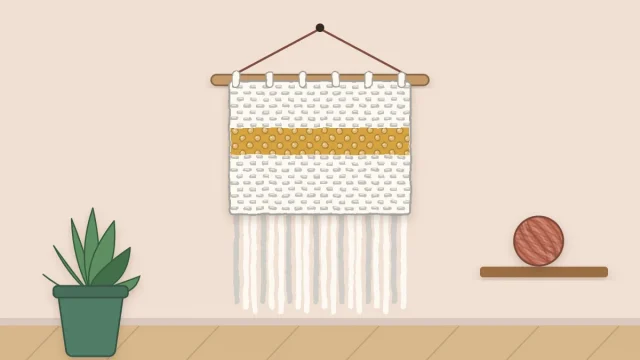
| Wooden dowel | Rectangular panels, pocket organizers | A fold-over casing, or loops worked around the dowel |
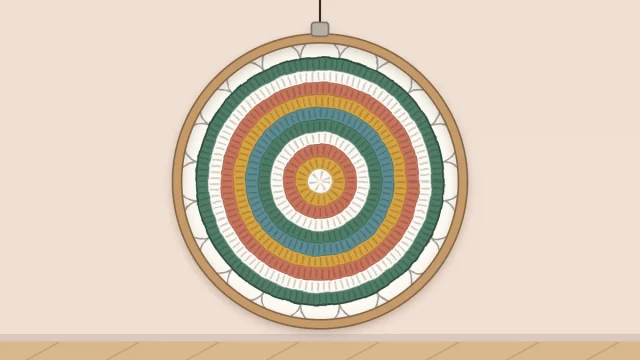
| Embroidery hoop | Round motifs and mandalas | Clamped between the two rings or laced to the inner ring |
| Metal ring | Mandalas and open, lacy rounds | Laced on with yarn, or the last round worked over the ring |
| Driftwood or a branch | Fringed, rustic hangings | Tied on with yarn loops along the top edge |
| Cord only | Garlands and bunting | Each end tied to its own hook |
For a dowel, choose one that extends 1 to 2 in (2.5 to 5 cm) past the fabric on each side, and sand the cut ends so they do not snag the yarn. Tie a hanging cord to both ends and let it rise to a peak 3 to 4 in (8 to 10 cm) above the dowel. A simple crochet wall hanging on a dowel is the easiest format to mount, because the cord levels itself on a single nail.
For hoops and rings, the support should be the same size as the blocked motif or slightly larger, so the fabric is stretched gently rather than bunched. The lacing method is explained step by step in the crochet mandala wall art tutorial. Driftwood is forgiving: its uneven line hides a top edge that is not perfectly straight.
Removable hooks or nails?
Both work. The choice comes down to the wall surface and the weight of the piece once it is in use.
- Removable adhesive hooks leave no holes, which suits rentals and painted doors. They need a smooth, clean, painted surface and usually fail on textured walls or wallpaper. Check the weight rating printed on the package and stay under it.
- Small nails or picture hooks leave a tiny hole but grip on almost any wall and carry more weight. One nail is enough for a dowel or hoop.
- Two hooks are needed for a garland, one at each end. Add a third in the middle if the garland is longer than about 5 ft (1.5 m), or the center will sag.
Most crochet wall pieces are light, but a pocket organizer gets much heavier once it holds mail and keys. Judge it by its loaded weight, not its empty weight, and use a nail or screw for anything that will be filled.
Watch out
Never hang yarn pieces above candles, beside a fireplace opening, or near a stove or space heater. Fringe and garlands move in a draft, and yarn can scorch, melt or catch fire.
Keep the piece flat and square
A wall shows every curled corner. Three things keep crochet lying flat against it.
Block before mounting
Pin the piece to its intended measurements and let it dry completely before it goes anywhere near a dowel. Wet, steam and spray methods suit different fibers, and the guide to blocking and finishing crochet decor explains which to use. Weave in every end first, because loose tails are far more visible on a wall than on a pillow.
Stiffen lightly where needed
Small motifs, lacy rounds and pennants often benefit from light stiffening. Spray starch gives a soft hold. White craft glue thinned with an equal amount of water gives a firmer one. Test on a swatch first, since stiffeners can darken some colors and are hard to remove.
Add weight at the bottom
A panel that flips up at the lower edge needs weight. Fringe supplies it naturally. So does a second, thinner dowel slipped through a casing at the bottom. Dense stitches sag less than open ones, and a new piece often lengthens slightly in its first days on the wall, so trim fringe after it has hung for a few days rather than before.
Height, centering and grouping
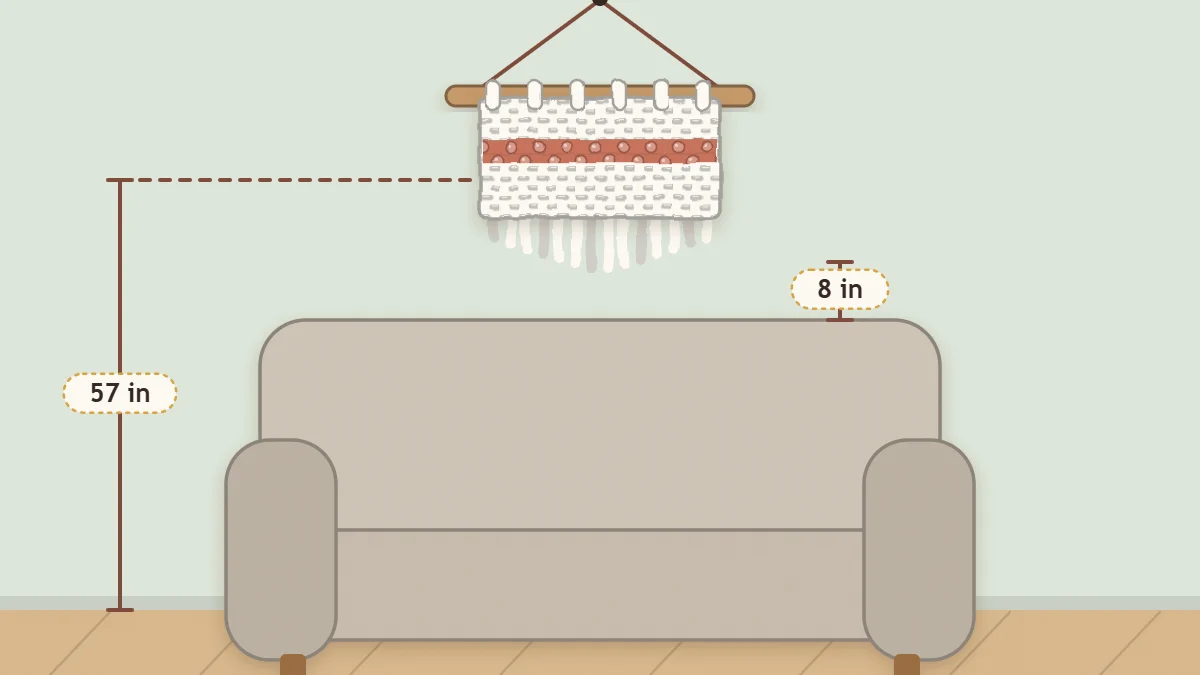
The usual gallery guideline is to put the center of a piece at about eye level, roughly 57 to 60 in (145 to 152 cm) from the floor. Measure the whole piece, fringe included, to find that center.
To mark the nail, pull the hanging cord up into its peak and measure from the peak down to the center of the piece. Add that number to your center height. If the center should sit at 58 in (147 cm) and the peak is 11 in (28 cm) above it, the nail goes at 69 in (175 cm).
Above furniture, eye level matters less than the relationship to the piece below:
- Leave 6 to 10 in (15 to 25 cm) between the top of a sofa back or headboard and the bottom edge of the hanging.
- Aim for a width of about two-thirds of the furniture. Over an 84 in (213 cm) sofa, that is about 56 in (142 cm), which usually means a group rather than a single piece.
- Center on the furniture, not on the wall, when the two do not line up.
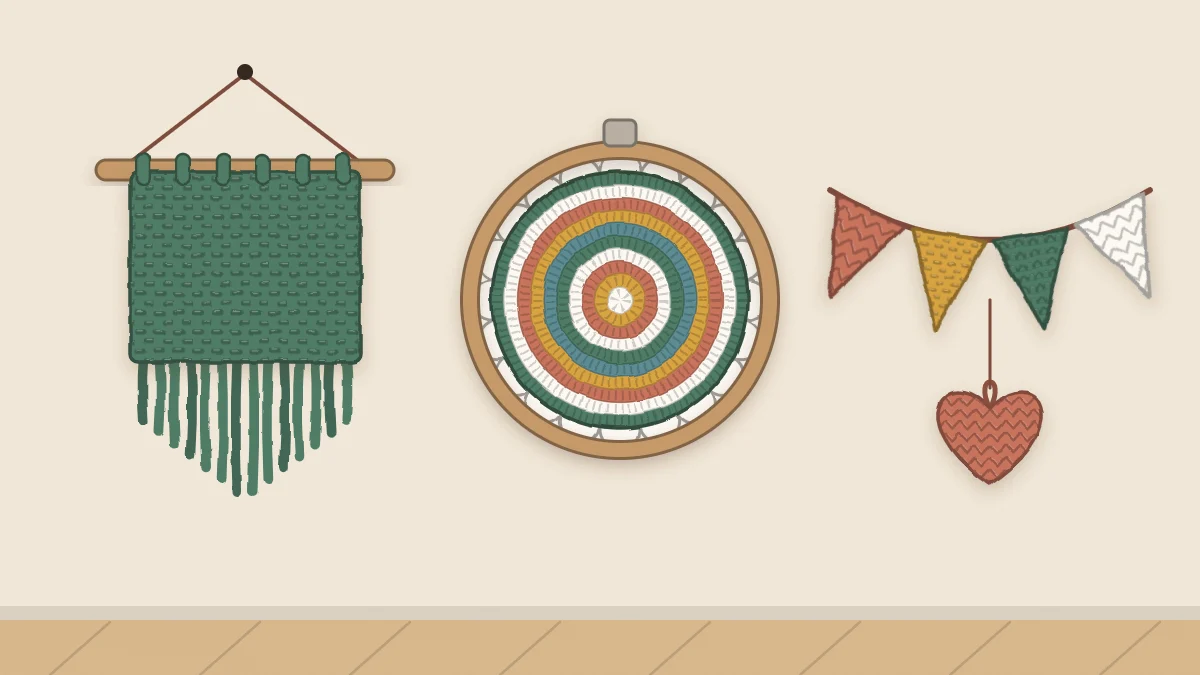
For a group, treat the whole arrangement as one shape and place its center at eye level. Keep 2 to 3 in (5 to 8 cm) between pieces. Lay everything out on the floor first, or tape paper cutouts to the wall, before making any holes. Mixing formats works well: a dowel hanging, a hoop and a short crochet bunting garland read as a set when they share two or three colors.
Protect it from sun and dust
Strong, direct sunlight fades dyed yarn over time, and darker and brighter shades show it first. A wall that gets hours of direct sun is a poor choice for a piece you want to keep for years. If there is no alternative, swap pieces between rooms each season so the fading stays even.
Dust settles into textured stitches. Every few weeks, take the piece down and shake it outdoors, or go over it with a lint roller or a soft, clean brush. A hair dryer on its cool setting clears fringe and bobbles. When a piece needs a real wash, remove it from its support, wash it gently by hand according to the fiber, then block it again before rehanging. Stiffened pieces lose their hold when washed and need a fresh coat.
Frequently asked questions
Can I hang a crochet piece without any dowel or hoop?
Small, stiffened motifs and garlands can hang from a cord or loop alone. Larger panels usually sag or curl along the top edge without something rigid, so a dowel, ring or branch is worth adding. Even a thin dowel hidden in a casing is enough to keep the top straight.
How long should the dowel be for a wall hanging?
A dowel that extends 1 to 2 inches past the fabric on each side looks balanced and leaves room to tie the hanging cord. For a 10 inch wide panel, that means a dowel about 12 to 14 inches long. Sand the cut ends so they do not catch the yarn.
Will adhesive hooks hold a crochet wall hanging?
They often will for light pieces on smooth, painted walls, as long as the piece weighs less than the rating on the package. They are less reliable on textured surfaces and wallpaper. For anything that will be filled or handled, such as a pocket organizer, a nail or screw is the safer choice.